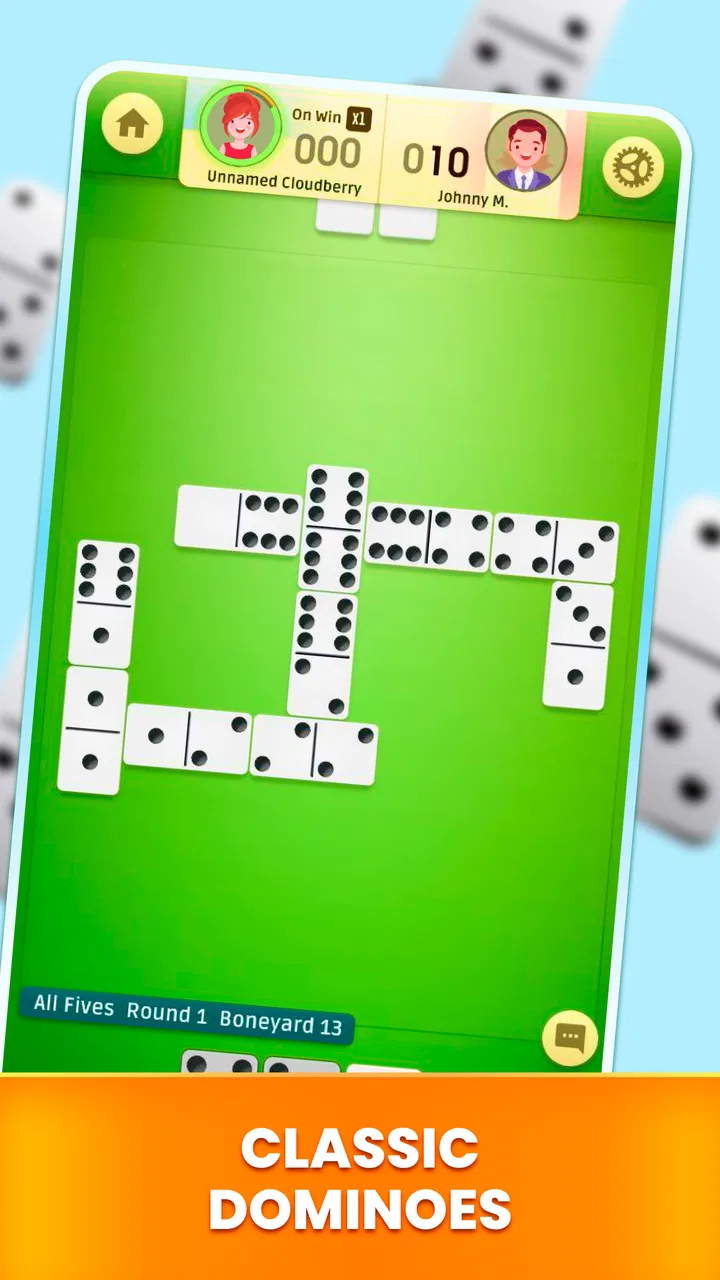
Dominoes: Classic Dominos Game
- 4.7
- Rating
- 10.00M
- Installs
- Free
- Price

 Analysis by App-foxy
I spent time with Dominoes: Classic Dominos Game as a simple board-game companion, and my first impression was that it understands the appeal of dominoes: the rules are familiar, the turns are easy to read, and a short session can fit into a spare moment. Developed by NewPubCo, this free board game is aimed at Everyone, so it is approachable for families, casual players, and anyone who wants a traditional tile game without setting up a physical table.
That simplicity is both its strongest quality and its main limitation. I would not choose it when I want a large adventure, a story, or a deep collection of modes to explore. I would choose it when I want to focus on matching tiles, planning a few moves ahead, and getting into a game quickly. The result is a clean, low-commitment experience that works best when you already enjoy dominoes or want an uncomplicated way to play.
How the first games establish a reason to keep playing
The early goal is easy to understand: make legal plays, avoid wasting useful tiles, and finish the round in a better position than the opposing side. That clarity matters. I never had to learn a complicated economy or decipher a long tutorial before making meaningful decisions. The board itself tells me what matters, and each turn gives me a small problem to solve.
You May Also Like

 Blood Strike: 2.5 Anniversary
Blood Strike’s Loadouts Turn Every Drop Into a Tactical Gamble
A close look at Blood Strike’s custom loadouts: how fast access to signature weapons reshapes its battle royale rhythm, rewards preparation, and narrows the gap between fights.

 Pandora - Music & Podcasts
Pandora’s Music Is Easy to Start, but Harder to Recover
Pandora’s strength is its low-effort path from a seed to a station. Its weak spot is how much confidence it asks you to place in connection, setup, and quiet recovery.

 8 Ball Pool
 Is Built on Rivalries, Rematches, and Routine
A close look at the rivalries, rematches, shared routines, and unanswered safety questions that turn a quick pool match into a persistent mobile community.

 Samsung Music
’s Quiet Strength Is Playing What You Already Own
Its reach comes less from spectacle than from dependable access to a personal library. That simplicity is both the app’s strongest retention engine and its ceiling.

 AccuWeather: Weather Radar
AccuWeather Review: A Quick, Clear Forecast for Everyday Decisions
For everyday plans, the best forecast is the one you can understand quickly. AccuWeather makes rain timing, radar, and local conditions easy to act on, with a few trade-offs.

 Hill Climb Racing
Why Hill Climb Racing Still Turns Crashes Into One More Run
A tiny car, a bumpy hill and one more upgrade: Hill Climb Racing keeps resurfacing because its simple chaos makes every near-miss feel personal.
More From Our News Desk
View All News


For a new player, this creates a gentle entry point. Dominoes has rules that many people already recognize, but digital play still requires a different kind of attention. I have to watch the open ends, remember which tiles have already appeared, and decide whether a move that works immediately might leave me with poor options later. Those choices are modest, yet they give the game more substance than a purely automatic matching exercise.
The strongest early motivation comes from improving my judgment rather than collecting an elaborate set of rewards. A round can show me exactly where I made a mistake: perhaps I opened an end that helped the other side, played a flexible tile too soon, or failed to keep track of likely possibilities. That feedback makes another attempt feel worthwhile because the next goal is personal and practical—play more carefully.
I also like that the game can be approached in short bursts. If I have only a few minutes, I can start a round without needing to remember a complicated storyline or prepare a large strategy. If I have more time, I can continue playing and look for patterns in my decisions. This makes it suitable for a commute, a waiting room, or a quiet break at home, provided I am comfortable with a game whose appeal comes from repeated board situations rather than dramatic variety.
What progress feels like during ordinary play
The progress signals here are mostly visible in the quality of my play. I notice improvement when I stop treating every legal move as equally good. A tile may fit now, but keeping it can preserve options for later. A move that looks defensive may be useful if it limits the number of comfortable responses available to the opponent. These are small lessons, but they give repeated rounds a sense of direction.
The game’s broad popularity also makes it easier to see why this format has staying power. It has an average rating of 4.7 from around 257 thousand ratings, with more than 8 million installs. Those figures do not replace personal experience, but they do suggest that the straightforward board-game format has found a substantial audience. I can understand that appeal: the rules are familiar enough to start quickly, while the decisions remain open-ended enough to reward attention.
My most useful habit was to pause before playing an obvious match. I would check both open ends, consider whether the tile in my hand was unusually flexible, and ask which move would leave me with the most future choices. This is not a flashy feature, but it changes the way the game feels. Instead of tapping the first available option, I start treating each turn as a small resource decision.
Another practical tip is to pay attention to what the opponent cannot play, not only what they do play. When a particular number remains absent from their moves, that can influence how I choose an open end. I would not call this a guaranteed prediction method, but it gives experienced players something to think about and helps the game remain mentally active after the basic rules become familiar.
There is also a useful trade-off between speed and information. Playing quickly keeps the session relaxed, but it makes it easier to overlook a better placement. Taking a little longer improves my decisions, yet it can reduce the casual, effortless quality that makes a digital domino game attractive in the first place. I appreciate that the game supports both approaches without forcing me to treat every round like a serious tournament.
Difficulty, mistakes, and the shape of a session
The difficulty curve feels less like a dramatic climb and more like a gradual test of awareness. At the beginning, I am mainly checking whether a tile fits. With experience, I start thinking about distribution, flexibility, and the consequences of changing the open ends. The game therefore becomes harder through better decision-making rather than through a complicated list of new rules.
That is a good fit for players who enjoy traditional board games. I can improve without memorizing a large rulebook, and a loss usually feels understandable rather than arbitrary. At the same time, anyone looking for clearly staged challenges may find the progression restrained. The central activity remains dominoes, so the game cannot provide the same sense of escalation as a puzzle game with new mechanics or a strategy game with expanding systems.
My advice for beginners is not to focus only on winning the current exchange. Try to preserve options and observe how the board changes after each placement. If a move leaves several possible responses, it may be more valuable than one that simply gets rid of a tile immediately. This approach makes the learning curve feel fair because improvement comes from noticing consequences, not from discovering a hidden trick.
For experienced domino players, the challenge depends heavily on how much attention they bring to the round. Someone who plays by instinct may finish quickly, while someone who tracks the visible tiles and plans around the open ends can find more depth. That flexibility is a strength, though it also means the game may feel too light for players who want a highly structured competitive ladder or a long-term campaign.
The pacing is generally well suited to casual use. Individual turns are easy to understand, and the board state does not demand constant concentration in the way a complex strategy title might. I can play while taking a short break and still feel involved. The downside is that the same relaxed rhythm can become repetitive if I play for a long stretch without changing my approach. The game rewards better decisions, but it does not transform the basic act of placing dominoes into something radically different.
Where retention works and where it may feel limited
The reason to return is the familiar loop: start a round, read the board, make a sequence of choices, and see whether a more disciplined plan produces a better result. I find that loop effective when I want a calm mental exercise. It is especially appealing after I have made a careless mistake and want to try the same kind of situation with more patience.
Still, the retention pressure is gentle rather than aggressive. There is no need for me to chase a story cliffhanger or maintain a large collection of characters. The game asks whether I enjoy the core board activity enough to play another round. That can be refreshing for people who dislike constant notifications, complicated progression tracks, or systems designed to keep attention through endless tasks.
On the other hand, players who need frequent unlocks, changing objectives, or a strong sense of accumulation may run out of motivation. The available information identifies the product as a free game with in-app purchases ranging from $0.99 to $69.99 per item, so I would approach optional spending carefully and decide in advance whether the basic play experience already meets my needs. For me, a domino game should remain enjoyable without making purchases feel necessary for ordinary sessions.
This is also where it differs from physical dominoes. A real set offers social presence, tactile handling, and the pleasure of sitting across from another person. This app is more convenient: it is ready whenever I want a round and does not require another player or a table. But convenience cannot fully replace the social atmosphere of a face-to-face game. If your main reason for playing dominoes is conversation with friends or family, a physical set may still be the better choice.
Compared with a broad collection of digital board games, this title is narrower and easier to understand. A board-game bundle gives more variety, but it also divides attention among many rules and interfaces. Here, the benefit is focus. I can open it knowing exactly what kind of experience I am getting. Compared with a puzzle game, it offers less visual novelty but more room for reading an opponent’s possible options. Compared with a competitive strategy game, it is lighter, faster to learn, and less demanding in terms of long-term planning.
Everyday use, audience fit, and practical trade-offs
A realistic use case is a short evening break when I want something interactive but not emotionally intense. I can play a few rounds, concentrate on the board, and stop without feeling that I have abandoned a larger campaign. It also suits someone introducing a younger player to basic turn-taking and matching decisions, helped by the Everyone content rating. Adults who want a quiet way to sharpen attention may enjoy it for the same reason.
I would recommend it most strongly to three kinds of players: people returning to dominoes after a long break, casual players who prefer familiar rules, and board-game fans who want a focused digital option between longer sessions. It is less suitable for someone who expects a rich narrative, a large tactical sandbox, or a constant stream of new mechanics. It may also disappoint players whose priority is the social feel of playing with people physically present.
The free entry point makes trying it straightforward, while the current version, 3.17.1, indicates that the app is maintained as a continuing product rather than a one-off experiment. On Android, it requires version 9 or later, which is worth checking before installing. I would also keep the purchase model in mind: the game is easy to sample without paying, but anyone who dislikes optional purchase prompts should pay attention during setup and play rather than assuming every part of the experience is entirely free.
One small workflow helped me get more from it: I treated the first few rounds as observation rather than as tests I had to win. I looked for which tiles created flexibility, noted when an open end became dangerous, and only then started trying to optimize my results. This made the game feel less repetitive because every round became a chance to examine one decision. It is a better approach than rushing through matches and judging the app solely by the win-loss outcome.
I also found that the best session length depends on my goal. For relaxation, a brief round is enough. For improvement, I need several rounds so I can compare mistakes and notice recurring habits. Playing indefinitely does not automatically create more depth; deliberate attention does. That is an important distinction for anyone deciding whether the game will remain interesting over time.
My verdict on the progression and long-term appeal
As a progression-focused game, this is modest. Its goals are clear, its feedback comes from the board, and its difficulty grows mainly as the player learns to make more thoughtful choices. That is not a weakness by itself. In fact, it is exactly why I find it comfortable to revisit. The game does not bury the domino experience beneath layers of systems that are unrelated to placing tiles.
Its limitation is equally clear: the long-term motivation depends on enjoying the core rules. If you need unlocks, dramatic milestones, or a visibly expanding challenge structure, the pacing may feel too quiet. If you value a dependable board-game loop that can be learned quickly and refined gradually, the restraint works in its favor.
NewPubCo has made a free domino game that is easy to approach and surprisingly thoughtful when I stop playing automatically. The 4.7 average and large install base fit the experience I had: it is accessible, familiar, and polished enough to attract many casual players. I would recommend giving it a try if you want a portable version of dominoes with room for better decision-making. I would skip it only if your idea of a satisfying game requires a story, extensive variety, or the social warmth of a physical table.
My final recommendation is simple: use it as a focused board-game break, not as a substitute for every kind of entertainment. Start slowly, watch the open ends, protect flexible tiles, and let your decisions—not imagined rewards—provide the sense of progress. For a straightforward domino session that respects your time, this is a solid choice.
FAQs for Dominoes: Classic Dominos Game
01What are the main features of Dominoes: Classic Dominos Game?
Dominoes: Classic Dominos Game offers a variety of game modes, including Block, Draw, and All Fives. It features intuitive controls, customizable themes, and the ability to play offline or against friends online. There are also helpful tutorials for beginners and a scoring system that keeps gameplay competitive and engaging.
02Is Dominoes: Classic Dominos Game available for free?
Yes, Dominoes: Classic Dominos Game is available for free on both Android and iOS devices. While the core game is free, there are optional in-app purchases and ads. These purchases can enhance the gaming experience by unlocking additional themes or removing ads.
03Can I play Dominoes: Classic Dominos Game offline?
Absolutely! Dominoes: Classic Dominos Game allows players to enjoy the game offline. This feature makes it convenient to play anywhere, whether you're commuting or in an area with limited internet access, providing endless entertainment without requiring a data connection.
04How can I play with friends in Dominoes: Classic Dominos Game?
To play with friends, you can connect through social media or use the in-game friend invite system. Once connected, you can create private matches or join public games together. This social feature adds a competitive edge and allows for fun interactions with friends.
05Are there any age restrictions for Dominoes: Classic Dominos Game?
The game is suitable for players of all ages, making it a family-friendly option. It’s designed to be easy to understand for younger players while still challenging enough to keep adults engaged. The game does not feature any inappropriate content, ensuring a safe environment for kids.
Pros
- Classic gameplay with intuitive controls.
- Multiple game modes for varied fun.
- Offline play available without ads.
- Easy to learn with helpful tutorials.
- Customizable tile themes and backgrounds.
Cons
- Limited multiplayer features.
- Occasional in-app purchase prompts.
- No leaderboard for competitive play.
- Graphics are basic and lack flair.
- Sound effects can be repetitive.

Dominoes: Classic Dominos Game
Gallery